
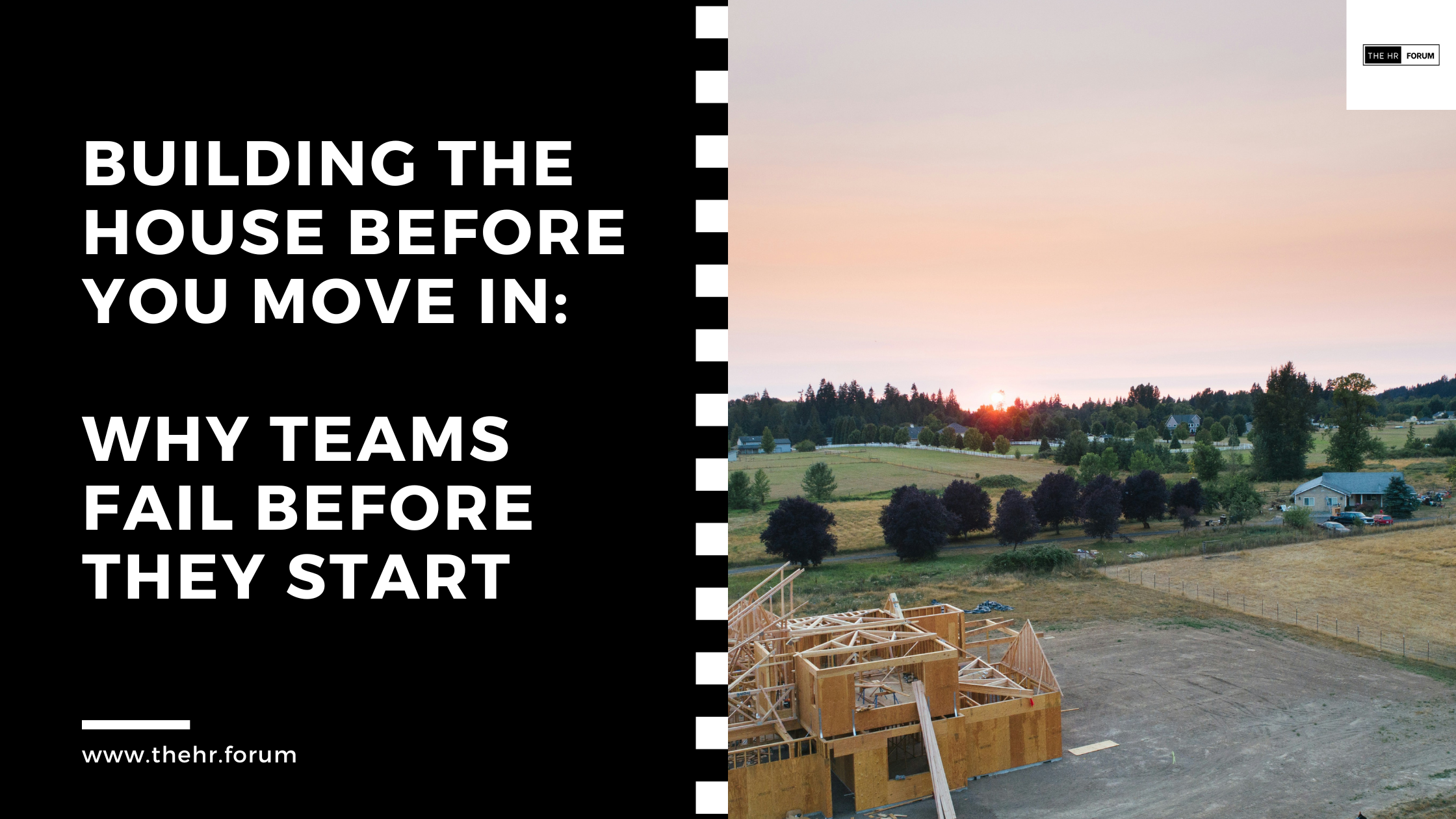
Building the House Before You Move In: Why Teams Fail Before They Start
By Kenneth Pennington, Chief Reality Officer, It’s Just a Fish
Most teams fail not because they lack talent.
They fail because nobody built the house before everyone moved in.
We hire good people. We give them goals. We expect them to figure it out.
Then we’re surprised when they don’t know how to disagree productively, don’t feel safe raising concerns, and don’t trust their manager to admit when they’ve got it wrong.
Here’s the uncomfortable truth: you can’t retrofit psychological safety.
You can’t bolt on trust after the damage is done.
You have to build it first.
After leading HR at Director and CHRO levels across aviation, financial services, pharmaceuticals, and media, I’ve watched this pattern repeat.
Leaders skip the foundation work because it feels slow.
Then they spend years managing the dysfunction that predictably follows.
There’s a better way.
It starts with three things.
1. Operating Principles: Know the Rules Before the Game Starts
Every team needs explicit agreements about how they work.
Not corporate values printed on posters.
Actual, observable behaviours that everyone commits to and can be called out on.
What decisions can team members make alone? How do we disagree? What happens when someone misses a commitment? What can the team expect from their manager?
Most leaders assume people will “just get it.”
They won’t.
And the gap between unspoken expectations and actual behaviour is where dysfunction breeds.
Operating principles answer the practical questions before they become conflict.
They make the implicit explicit. And critically, they apply to leadership too, not just the team.
2. Leadership Vulnerability: Model What You Want to See
Here’s what most leadership programmes get wrong: they teach leaders to project confidence and hide uncertainty.
The result?
Teams that don’t trust their managers, because they sense the performance but can’t see the human.
Vulnerable leadership doesn’t mean weakness.
It means:
– I listen. Genuinely. Not waiting to speak.
– I learn. I change my mind when presented with better information.
– I make mistakes. And I name them publicly.
When a leader admits they got something wrong, they give permission for everyone else to do the same.
When a leader asks for help, they signal that not knowing isn’t failure.
This isn’t about being soft.
It’s about being real.
Teams follow leaders they trust, and trust is built on honesty, not infallibility.
3. Psychological Safety: Build the House So People Can Speak
Psychological safety isn’t a nice-to-have.
It’s the foundation everything else sits on.
Without it, problems stay hidden until they’re crises.
Ideas die unspoken.
Talented people leave because they’re exhausted from navigating politics instead of doing work.
Psychological safety means your team has a seat at the table. They can speak up without fear. They can make mistakes and learn from them rather than hide them.
They grow together with you, not despite you.
This doesn’t happen by accident. It requires consistent behaviour from leadership, clear structures that make speaking up safe, and consequences when people are punished for honesty.
The Blind Spot Problem
Here’s the thing I’ve learned the hard way: leaders can’t see their own blind spots.
You can read every book on psychological safety.
You can genuinely want to build a healthy team.
But you’re inside the system.
You have relationships, history, assumptions, and biases you can’t see.
Sometimes leaders try to do this work alone. They run the diagnostic themselves. They design the intervention. And they miss the patterns that are obvious to anyone standing outside.
That’s where a partner helps.
Someone who can see the dynamics you’re too close to notice. Someone who’ll put the smelly fish on the table, the obvious problem everyone’s pretending doesn’t exist.
What I Do
At It’s Just a Fish, I work with leaders who know something isn’t working but can’t quite see what. I help identify where the operating principles are missing, where leadership vulnerability is blocked, and where psychological safety has been compromised.
Then we build a plan.
Not a 50-slide deck of theory.
Practical moves you can make this month. I’m the boots on the ground with you, observing patterns, naming what I see, and helping you address the dysfunction that’s been holding your team back.
If you’re a leader who senses something is off but can’t put your finger on it, let’s talk.
Connect with Kenneth Pennington:
Follow for the newsletter on organisational reality, difficult conversations, and putting fish on the table.
It’s Just a Fish — Thinking differently about people and change.
About the Author
Kenneth Pennington is Chief Reality Officer at It’s Just a Fish, an HR consultancy specialising in fractional CHRO services, interim leadership, and organisational change. He brings Director and CHRO-level experience across aviation technology, financial services, pharmaceuticals, media, and telecommunications, with an educational background in organisational behaviour, visual arts, change, and executive coaching—because sometimes you need to see problems differently before you can solve them.
Kenneth recently co-authored the whitepaper Aspirational Hiring: Why Your Future-Perfect Hire Is Failing Right Now with Paul Withers of The HR Guys.
The HR Forum is brought to you by The HR Guys
